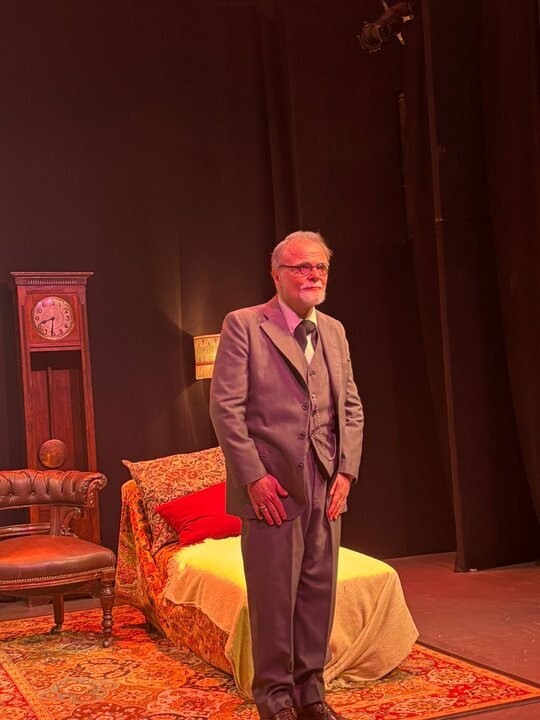
Argentine actor Luis Machín analyzed the process of building his character in the play 'The Last Session of Freud' and described the technical, emotional, and investigative work that supports his interpretation of the creator of psychoanalysis. In an exclusive interview with the Argentine News Agency, the artist explained how he approached the figure of Sigmund Freud through acting freedom, the study of available materials, and the experience accumulated over hundreds of performances. Machín stated that interpreting a historical figure of Freud's magnitude on stage generates a particular demand. He also pointed out that the audience arrives with prior expectations based on readings, studies, photos, and cultural references, and noted that this demand creates a kind of 'plus' in the reception of the play. The performer indicated that many psychology students and professionals told him after the performances that they recognize the Freud they studied in the character, and defined this reaction as 'impressive'. The actor explained that the spectator forms an image of the character in their mind based on their own passage, and that theater achieves its best effect when that story is built in the head of the viewer. Likewise, he specified that this mental construction of the public coexists with the creative freedom of the actor, both when interpreting fictional characters and when embodying historical figures with a proven legacy. The interviewee detailed that the play takes place in the final stretch of Freud's life, when the doctor was 83 years old and was days away from his decision to die, and that this biographical data was central to his composition and that he worked to approach the physically Freud of that stage. The artist emphasized that there is only one recording of Freud's voice and that this recording shows a difficulty in speech due to the prosthesis he used after the reconstruction of the upper jaw and palate. There, he explained that he incorporated this information into his vocal work, although he clarified that he could not reproduce it literally because theater requires clear emission, good diction, and sufficient volume for the public to understand the text. The actor stated that he worked on the physiognomy of the mouth and the idea of a loose prosthesis to influence the way of speaking without losing sound clarity. He also described that this type of denture modifies the emission times and the selection of words, and affirmed that he took that concrete reference to add verisimilitude to the character. On the other hand, he commented that he participated in this same play since 2012, but at that time he played the other character in the text (C.S. Lewis). The initiative was his own after the pandemic and he managed the return of the show with the same creative team. The artist added that he proposed the role change to the original cast and that, due to the impossibility of repeating the previous cast, they called a new partner for the scene. He also described the evolution of the play over time and affirmed that no function is identical to another, since repetition produces growth but goes through critical stages in which the dynamics break down and then reorganize. The performer warned that there is a frequent temptation to seek the immediate laughter of the public and that this resource can deviate the tone of plays that are not pure comedies towards an 'excessive histrionism'. It was learned that the piece accumulates more than two thousand performances adding its different stages and that the experience with the public is diverse and rich, so, he defined his main objective as the search for a direct emotional impact on the spectator and assured that he takes care of the technical details to achieve an intimate and sensitive arrival. Likewise, he indicated that he nourished himself from readings, from the few audiovisual images available of Freud, from exchanges with his own psychoanalyst, and that therapy serves him to review aspects of his work and that he especially values human exchange over automatic sources of information. Regarding the current status of the play, Machín confirmed that the performances continue with high attendance and specified the usual schedules: Sundays at 6:30 p.m. and Mondays at 8:00 p.m. Finally, he gave us an exclusive about the show that will also be presented at the Metropolitan Theater during the Sundays of May, June, and July.